
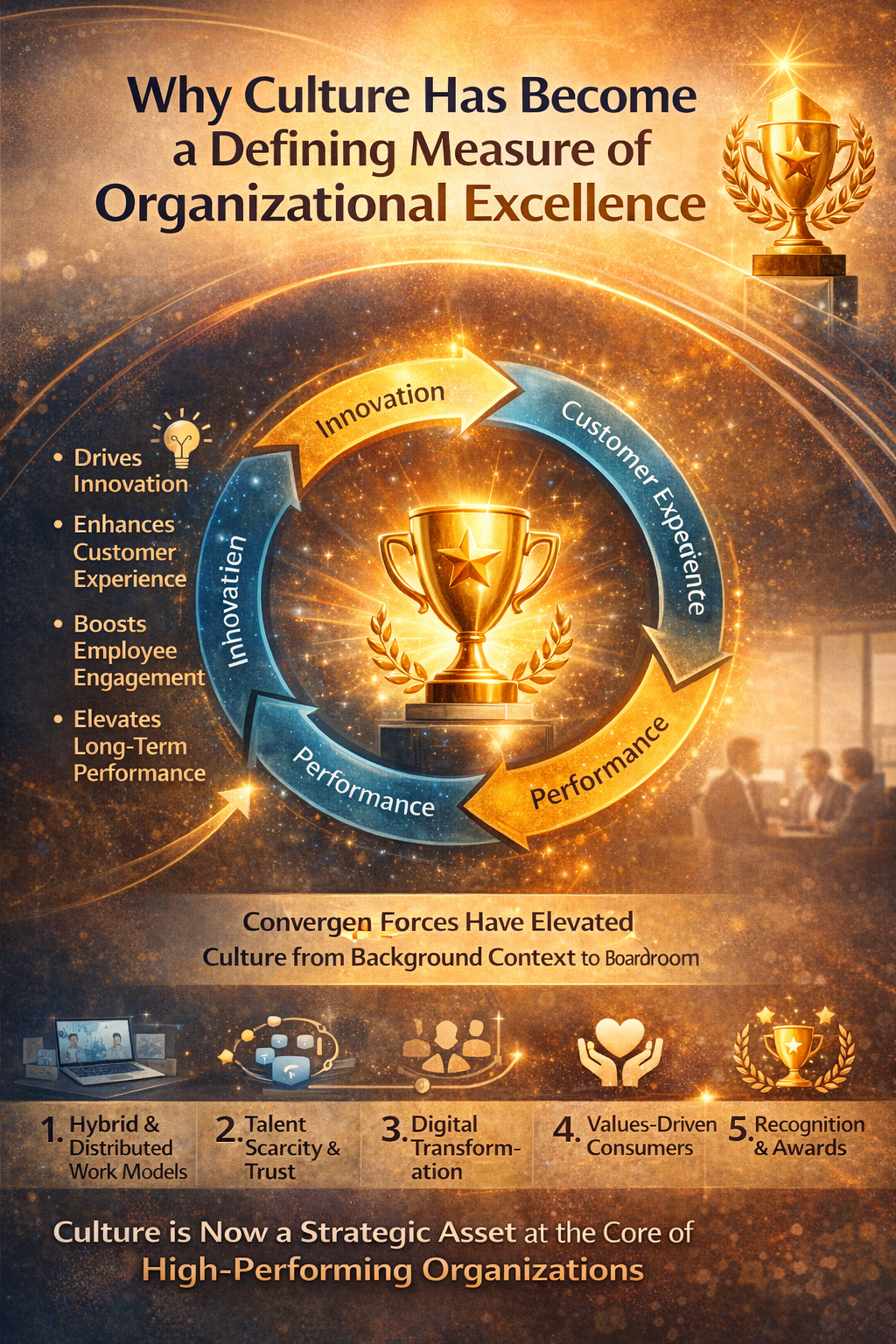
Why Culture Has Become a Defining Measure of Organizational Excellence
In an increasingly complex and competitive business environment, organizational success is no longer driven solely by strategy, technology, or market position. Today, one factor consistently differentiates high-performing, award-recognized organizations from the rest: culture.
Organizational culture—once considered intangible or “soft”—has become a measurable, strategic asset directly linked to innovation, customer experience, employee engagement, and long-term performance. This shift explains why excellence councils, leadership juries, and global awards are placing unprecedented emphasis on cultural maturity as a benchmark for recognition.
Cultural excellence is no longer about aspirational values printed on walls. It is about how values translate into daily behaviors, decision-making, and outcomes.
Why Culture Is Trending Now
Several converging forces have elevated culture from background context to boardroom priority:
-
Hybrid and distributed work models demand stronger cultural coherence
-
Talent scarcity places emphasis on purpose, belonging, and trust
-
Digital transformation requires adaptive, learning-oriented cultures
-
Customers increasingly align with brands whose values they trust
-
Recognition frameworks now assess culture as a driver of sustainable impact
As a result, culture is being evaluated not as a sentiment—but as a performance system.
Culture as a Performance Engine
At its core, culture answers three operational questions:
-
How do people make decisions when policies are unclear?
-
How do teams behave under pressure or uncertainty?
-
What behaviors are truly rewarded, not just stated?
Organizations with strong cultures show consistent alignment between:
-
stated values,
-
leadership behavior,
-
systems and incentives,
-
employee experience,
-
and customer outcomes.
This alignment enables speed, innovation, and accountability—without reliance on excessive control or bureaucracy.
How Culture Fuels Innovation
Innovation does not emerge from process alone; it emerges from psychological safety and trust.
Award-recognized organizations consistently demonstrate cultures that:
-
encourage experimentation without fear of failure,
-
support cross-functional collaboration,
-
value learning over perfection,
-
reward curiosity and initiative.
In these environments, innovation becomes continuous rather than episodic.
For example, organizations with high cultural alignment report:
-
faster idea-to-implementation cycles,
-
higher internal mobility,
-
stronger adoption of new technologies,
-
and greater employee ownership of outcomes.
Culture, in this context, becomes the infrastructure of innovation.
The Link Between Culture and Customer Outcomes
Customer experience is a downstream reflection of employee experience.
Organizations with strong cultures:
-
empower frontline teams to act decisively,
-
encourage empathy-driven problem solving,
-
maintain consistency across touchpoints,
-
and foster accountability without rigidity.
Excellence councils increasingly recognize this link—evaluating not only customer metrics, but also the cultural conditions that produce them.
When values are lived internally, customers experience them externally.
Measuring Culture: From Intuition to Insight
One reason culture is gaining recognition traction is its increasing measurability.
Leading organizations assess culture through a combination of:
-
engagement and pulse surveys,
-
behavioral analytics,
-
leadership feedback loops,
-
internal mobility data,
-
learning participation patterns,
-
customer feedback correlations.
Rather than relying on annual surveys alone, cultural leaders track behavioral signals in real time—allowing proactive intervention and continuous improvement.
Culture becomes something leaders can observe, adjust, and strengthen—not merely describe.
Strategies to Elevate Cultural Excellence
Organizations recognized for cultural excellence typically apply several core strategies:
1. Translate Values into Observable Behaviors
Values are operationalized through clear behavioral expectations:
-
how leaders lead,
-
how teams collaborate,
-
how decisions are made.
This clarity eliminates ambiguity and reinforces consistency.
2. Align Leadership Capability with Cultural Intent
Culture follows leadership behavior.
Recognized organizations invest in:
-
leadership self-awareness,
-
emotional intelligence,
-
inclusive decision-making,
-
coaching-oriented leadership models.
Culture is sustained when leaders are held accountable not only for results—but for how results are achieved.
3. Embed Culture into Systems and Processes
Cultural alignment is reinforced through:
-
performance management,
-
learning and development,
-
recognition programs,
-
talent mobility frameworks,
-
feedback mechanisms.
When systems reinforce values, culture scales naturally.
4. Listen Continuously
High-performing cultures are adaptive.
They rely on:
-
frequent listening mechanisms,
-
employee voice platforms,
-
rapid feedback cycles,
-
and transparent communication.
This responsiveness builds trust and resilience—especially during change.
Real-World Examples from Recognized Organizations
Organizations recognized by excellence councils and industry awards often demonstrate:
-
high employee trust scores alongside strong financial performance
-
leadership behaviors aligned with stated values
-
consistent customer satisfaction driven by empowered teams
-
evidence of cultural evolution—not static initiatives
Their success lies not in perfect cultures, but in intentional, evolving ones.
Why Cultural Excellence Is Central to Recognition Standards
Award frameworks are shifting from output-only evaluation to sustainability and integrity of impact.
Cultural excellence demonstrates:
-
long-term leadership capability,
-
resilience during disruption,
-
ethical decision-making,
-
and people-centered growth.
Recognition bodies increasingly ask:
-
Is performance repeatable?
-
Is leadership scalable?
-
Is success rooted in values or dependent on individuals?
Culture provides the answer.
Final Thought: Culture Is the Strategy Behind the Strategy
Cultural excellence is not an initiative—it is an operating system.
Organizations that align values with performance do more than succeed; they endure. They innovate with purpose, serve customers with authenticity, and attract talent through trust—not incentives alone.
As recognition standards evolve, culture is no longer a differentiator.
It is the foundation.
For organizations seeking excellence, the question is no longer whether culture matters—but how deliberately it is designed, measured, and lived.
0 Comments